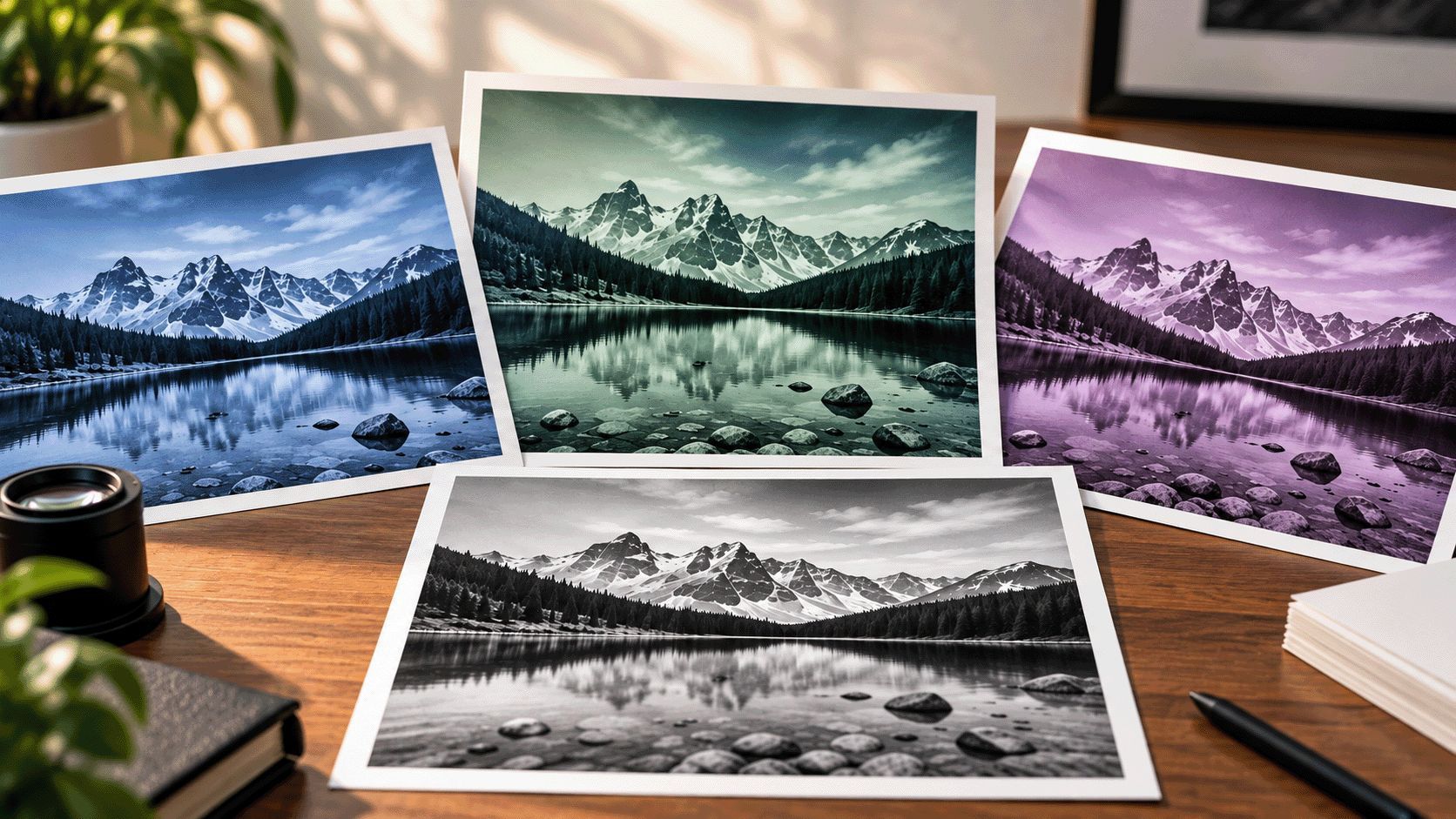
What do we mean by: True Black & White Prints?
TRUE Black & White Printing: What We Really Mean

TRUE Black & White Printing: What We Really Mean
In today’s digital world, the phrase black & white printing gets used loosely — often to describe any grayscale image produced on an inkjet, laser or color photographic printer. While those methods certainly create monochrome images, they aren’t what we mean when we talk about TRUE Black & White printing. For us, “true” is not just a stylistic label — it reflects a very specific photographic process rooted in craftsmanship, chemistry, and tradition. So what makes it different?
Not Just Grayscale — A Black & White Photographic Process
Many modern black & white prints are made by combining colored inks to simulate shades of gray. Even when black ink is used, additional cyan, magenta, or yellow inks often contribute to tonal rendering. While efficient and convenient, this approach produces what is technically a color print composed to look monochrome.
Another widely used method of creating black and white photo prints is to print them on modern color photographic printing equipment using color photographic paper. The paper has only yellow, magenta and cyan sensitized color layers, no black or gray sensitive layers. Hence the print is made by combining the three colors to produce a neutral grayscale. This is why black and white photo prints made on color paper often have a slight tint of color.
TRUE Black & White printing, by contrast, is created using genuine silver-halide black and white photographic paper and traditional darkroom-style processing — even when the source file is digital. Instead of layering inks onto paper, the image is laser exposed at high resolution onto light-sensitive material and developed chemically. The tones are formed by metallic silver embedded in the paper itself. The result is fundamentally photographic, not ink-based and no color cast.
At Fromex, we print true black and white silver gelatin prints on Ilford Galerie Digital Silver B&W photographic paper and chemically process it using Ilford B&W paper developer.
The Difference You Can See
This distinction isn’t just technical — it’s visual and tactile. True photographic black & white prints offer:
- Richer tonal depth: Smooth transitions between highlights, midtones, and shadows that are difficult to replicate with ink.
- Neutral grayscale: No unwanted color shifts or metamerism under changing lighting conditions.
- Exceptional detail: Crisp rendering of fine textures and subtle gradations.
- Archival stability: Properly processed silver-based prints have proven longevity spanning decades.
Many photographers and artists immediately notice the dimensional quality — a sense of depth and presence — that comes from light interacting with photographic emulsion rather than ink sitting on a surface.
Why It Matters
Black & white photography is fundamentally about tone, contrast, and emotion. Without color to guide the viewer, every nuance of gray carries expressive weight. When prints are produced using traditional photographic materials, those tonal relationships are preserved with remarkable fidelity.
For fine art photographers, galleries, and collectors, this authenticity matters. It honors the intent of the image and maintains continuity with the historical craft of photography. Even for personal images, portraits, or exhibition prints, the difference elevates the final presentation from simple reproduction to photographic artwork.
Bridging Tradition and Digital Workflow
TRUE Black & White printing doesn’t mean abandoning modern technology. Today’s workflow allows digital files to be optimized with precision before laser exposure onto black and white photographic paper. This hybrid approach combines the control and flexibility of digital editing with the proven aesthetic and archival qualities of classic materials.
The result is the best of both worlds — modern convenience paired with time-tested visual integrity.
More Than a Label
Ultimately, when we say “TRUE,” we’re describing a commitment to authenticity. It’s about using processes that produce genuine photographic prints rather than simulations. It’s about respecting the tonal language of black & white imagery. And it’s about delivering a finished piece that looks, feels, and lasts like a photograph should.
In an era where shortcuts are common, true black & white printing stands apart — offering depth, permanence, and craftsmanship that continues to define the gold standard of monochrome photography.
Here is a link to the Fromex True B&W website page with more details about the True Black and White process: https://trueblackandwhiteprints.com/print-process.